
What a snagging report should contain before you accept handover
Handover is the moment a defect list stops being the developer's problem and starts being yours. Everything about snagging follows from that single fact, including the part most buyers get wrong, which is not what goes on the list but when the list is drawn up.
The short answer
A snagging report records every defect in a newly built property before handover is accepted, while the cost of rectifying them still sits with the developer. It should cover structure and finishes, every electrical point, plumbing and drainage, air conditioning run under load, doors, windows, fitted joinery, and the common areas the unit is sold with access to.
- When it happens
- Before handover is accepted, not after the keys are collected
- Why the date matters
- Acceptance moves the cost of the defect list from the developer to the owner
- Defects liability
- Commonly offered for a period after handover, but the length and what it covers differ by developer and by contract
- Structural defects
- Ten year decennial liability under Article 880 of the UAE Civil Transactions Law
- On a resale
- The report produces no obligation on anyone, and it is still the best information available before you complete
Why the date matters more than the list
A snagging report has no special legal status in Dubai. What gives it force is when it is produced. Before acceptance it is a list of things the developer is expected to put right at their own cost, because they have not yet delivered what the contract obliges them to deliver. After acceptance the same list is a maintenance schedule at the owner's expense, with an argument attached about which items were pre-existing.
This is why the sequence matters. The inspection happens after the developer calls handover and before the acceptance documents are signed, in the window most buyers do not realise exists, and which some are actively hurried through.
What a report should cover
A serious inspection takes two to three hours on an apartment and considerably longer on a villa. A report that arrives after forty minutes has looked at surfaces.
Structure and finishes
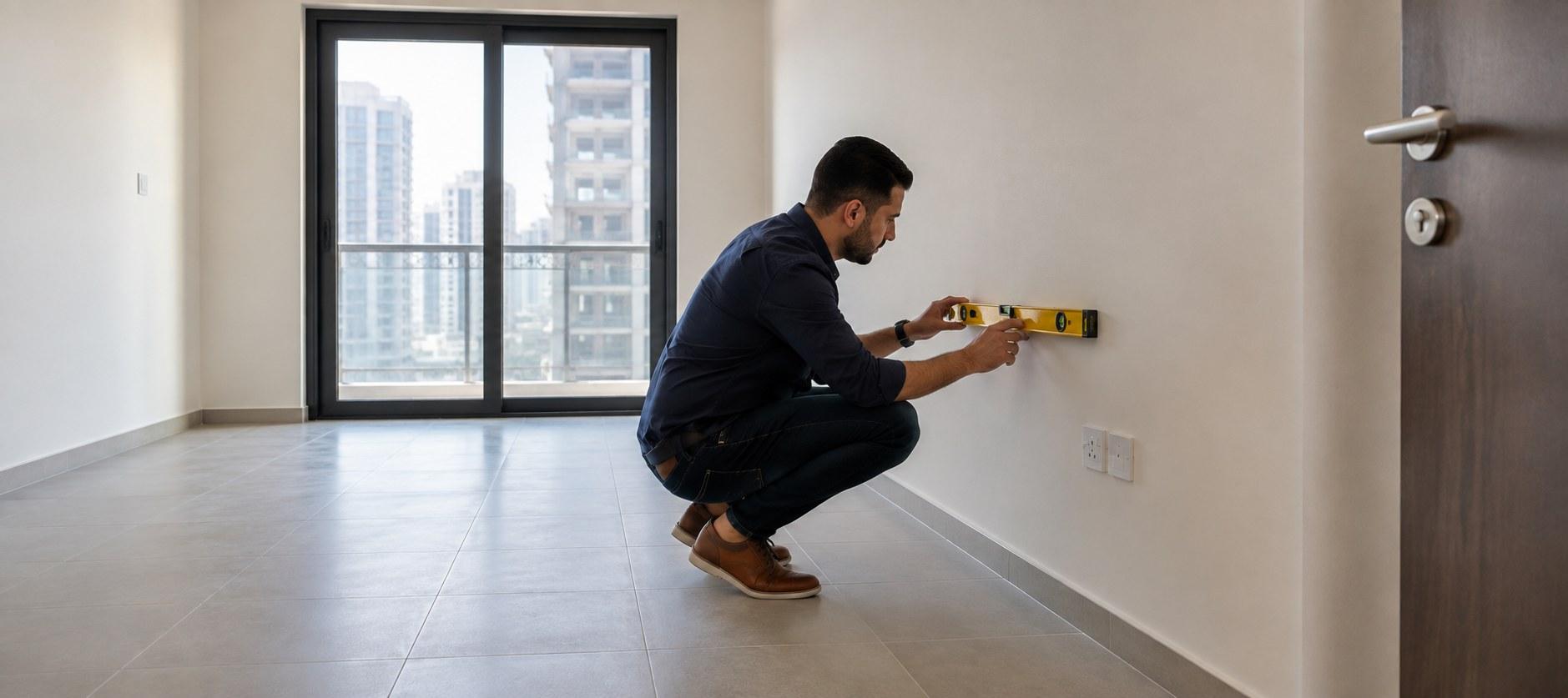
Walls, ceilings and floors checked for cracking, unevenness and hollow tiling. Paint and plaster finish. Skirting, joints and sealant lines. Level and plumb where it can be measured rather than eyeballed.
Every electrical point, individually
Every socket, switch, light point and data outlet tested rather than sampled, along with polarity, the distribution board labelling and the residual current device. A single reversed socket is a five minute fix for the developer and a call-out you pay for afterwards.
Plumbing and drainage under use
Every tap, mixer, shower and flush run. Pressure with more than one outlet open. Drainage checked for fall and for standing water, and traps checked for smell. Under-sink and behind-cistern areas checked for damp, which is where a slow leak shows first.
Air conditioning, run long enough to fail
The test that separates a real inspection from a walkthrough. Units run under load for an hour or more, because a fan coil that trips on a thermostat fault or drips from a blocked condensate line is fine for the first fifteen minutes. Check the drainage as well as the cooling.
Doors, windows and glazing
Every door and window opened, closed, locked and unlocked. Alignment, seals and handles. Glazing checked for scratching and for failed units. Balcony doors checked for weather sealing, which matters here in the two months a year it rains and every day the wind blows sand.
Fitted joinery and appliances
Wardrobes, kitchen units, drawers and soft-close mechanisms. Worktop joints and sealant. Every appliance supplied with the unit powered on and run through a cycle, along with the warranty documentation for each.
The common areas sold with the unit
Frequently omitted, and worth including: the parking bay is the right bay and the right size, storage sold with the unit exists and is accessible, and the amenities the building was sold on are complete rather than programmed for a later phase.
What happens after the report is submitted
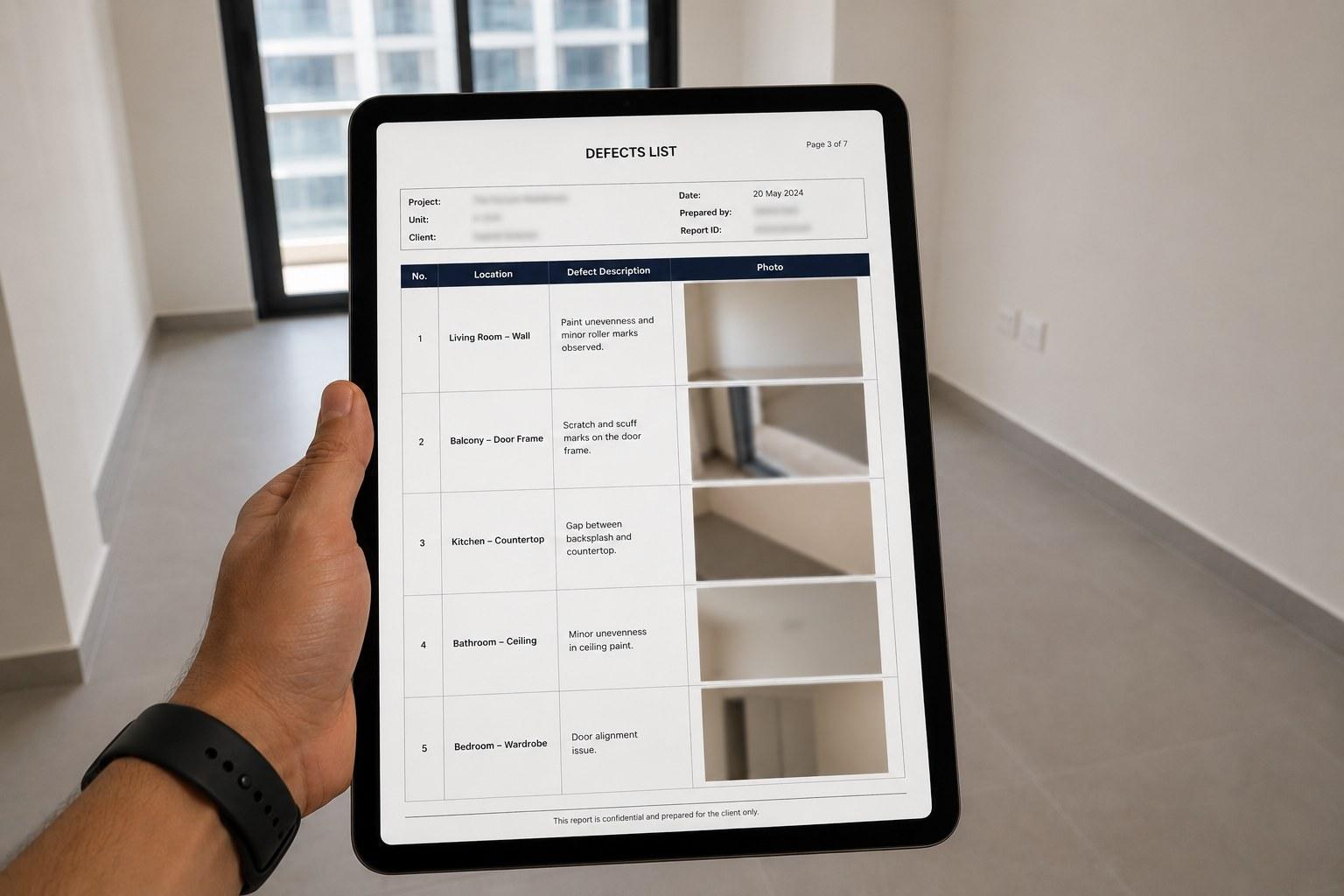
The report goes to the developer formally and in writing, with photographs against each item and a location for each. A list of adjectives is easy to dispute and a photographed, located, numbered list is not.
The developer rectifies, and then the property is re-inspected against the original list rather than looked at afresh. A re-inspection matters more than the first visit in one specific way: rectification work creates its own defects, and paint repairs, replaced tiles and re-sealed joints are exactly where the second round of items comes from.
Only then is acceptance signed. Where items remain outstanding at that point, they should be recorded on the acceptance document itself rather than agreed verbally, so that what is still owed is written on the thing that was signed.
Defects liability, and what it actually covers
Developers in Dubai commonly provide a defects liability period after handover, during which certain faults are rectified at their cost. The length of it and what falls inside it differ by developer and by contract, so the only reliable source is your own agreement rather than the figure someone quotes as standard.
Separately from anything in the contract, the UAE Civil Transactions Law provides for a ten year liability on structural defects, which covers the things that threaten the stability of the building rather than the finish inside it. That is a long tail on serious matters, and it is not a substitute for a defects liability period on everything else.
The practical consequence is that finishes, fittings and services are the items with a short window, and they are precisely the items a snagging report catches. A defect found at month two is usually somebody else's cost. The same defect found at month twenty usually is not.
Snagging a property you are buying second-hand
There is no developer to send the list to, and it is still worth doing. On a resale the report is not leverage, it is information: what condition you are actually buying in, what will need replacing, and roughly when. The air conditioning and the water heater are the two items that decide whether that matters, since both are expensive and both fail without warning.
Occasionally it is also a reason to renegotiate, which is a conversation that goes considerably better with a photographed report than with an impression formed during a twenty minute viewing.
What we do at handover
We snag before acceptance so the list is drawn while it is still the developer's to fix, submit it formally with photographs, re-inspect after rectification, and record anything outstanding on the acceptance document rather than agreeing it verbally.
After that we collect the handover, record the condition of the property with photographs, and either find a tenant or take over managing one already lined up. Coming to us at handover rather than six months afterwards is the difference between a defect list that costs the developer and one that costs you.
Owning, answered straight
The questions that come up most often on this, with the figures rather than a brochure answer.
It is the only point at which a defect list is somebody else's cost. Once handover is accepted, the same list becomes a maintenance schedule at the owner's expense along with an argument about which items were pre-existing. On a new build the report is leverage. The cost of it is a fraction of a single air conditioning replacement.
Be careful with this. Depending on the contract, delaying acceptance can put the buyer in breach and can start service charges and other obligations running regardless. The workable position is to inspect thoroughly before signing, submit the defect list formally with photographs, press for rectification and re-inspection, and record anything still outstanding on the acceptance document itself rather than agreeing it verbally.
It differs by developer and by contract, so the only reliable answer is the one in your own agreement rather than a figure quoted as standard. Separately, the UAE Civil Transactions Law provides for a ten year liability on structural defects, which covers matters affecting the stability of the building rather than finishes and fittings inside the unit.
Yes, and more buyers should. There is no developer to bill, so the report is information rather than leverage: what condition you are buying in, what needs replacing and roughly when. The air conditioning and the water heater are usually the items that decide whether it changes your view, and occasionally the report is the reason to renegotiate before completing.
The buyer commissions and pays for the inspection. The rectification of anything it finds is the developer's cost on a new build, provided the list is submitted before handover is accepted. That order is the whole economics of it: the inspection is paid for once and the defects it catches would otherwise be paid for repeatedly.
More on how Dubai property actually works.
Get the answer for your property
This page is general by definition. The version that matters accounts for your building, your service charge and the contract in front of you, and that is a conversation rather than an article.
What we will tell you
- Which end of the district
- Within one community the gap between two towers, or two streets, is routinely wider than the gap between communities. That is the part a portal map cannot show you.
- What the service charge does
- Read per square foot against the buildings beside it, because it comes out of the return every year and rarely appears in the pitch.
- What is still to be built
- The plot next door, what is approved on it, and which views are temporary. Worth knowing before you pay for one.
- What actually transacted
- Recent sale and lease prices in the specific building, rather than the asking prices still sitting on the portals.