
What escrow protects you from when you buy off-plan, and what it does not
Ask a developer whether an off-plan purchase is safe and the answer will be the escrow account. It is a real protection, it was introduced for good reason, and it addresses one specific failure. The risks that actually cost off-plan buyers money in this market are not the ones it was written to prevent, and no page selling you a unit is going to say so.
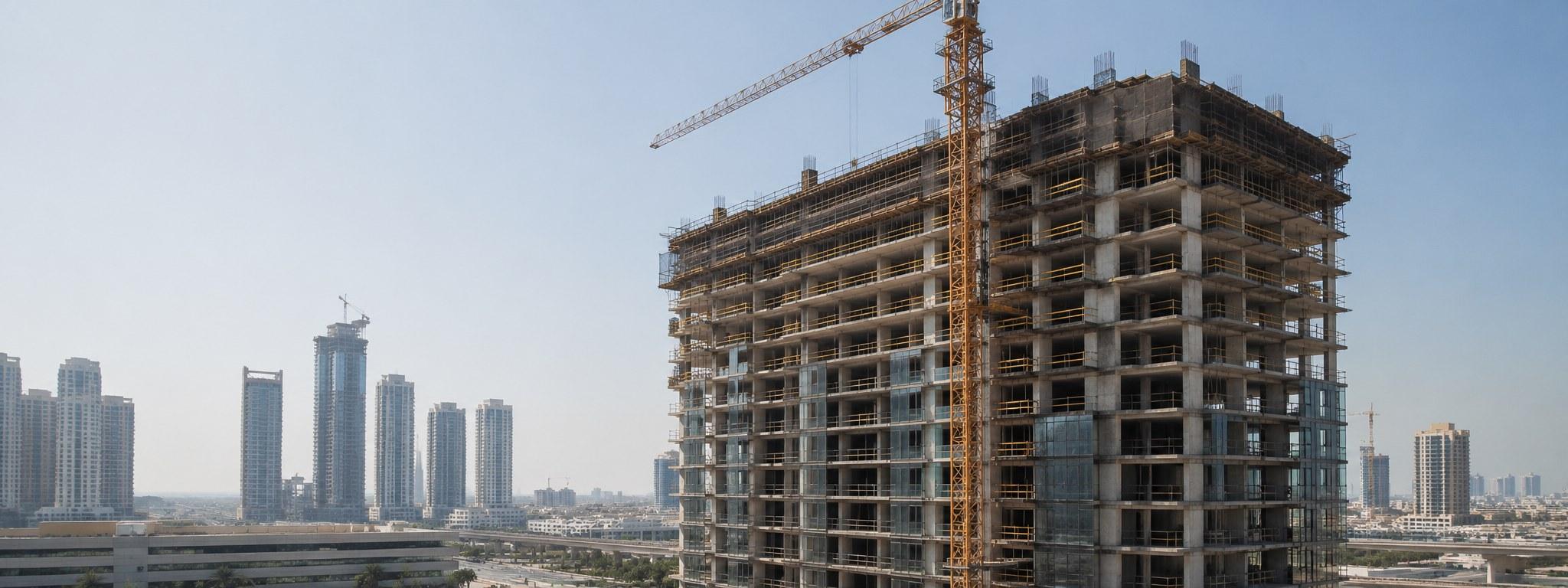
The short answer
Dubai requires a developer selling off-plan to pay buyer instalments into a project escrow account under Law No. 8 of 2007, with money released against verified construction progress. Escrow protects the money from being spent on other projects or on general working capital. It does not protect against delay, a changed specification, or a weaker market at handover.
- The law
- Law No. 8 of 2007 on escrow accounts for real estate development in Dubai
- What it does
- Holds buyer instalments per project and releases them against verified construction progress
- The register
- The purchase is recorded on the Land Department's interim register before any title deed exists
- What it does not cover
- Delay, specification drift, and the market at handover
- If you stop paying
- Termination runs through the regulator rather than at the developer's sole discretion
What the escrow account is
A developer selling off-plan in Dubai has to register the project with the regulator and open an escrow account tied to that specific project. Buyer instalments are paid into it rather than to the developer directly, and money is released from it against verified construction progress rather than on request.
The problem it was written to solve was specific and historical: money collected for one project being spent on another, or on the developer's general costs, leaving a hole that only became visible when the building stopped. Tying the money to the project and the release to the progress closes that particular door.
The three things escrow genuinely protects you from
These are real, and they are the reason buying off-plan in Dubai today is a different proposition from buying off-plan here twenty years ago.
Your money funding somebody else's project
The account is per project. Instalments paid against your building cannot lawfully be moved into another development that needs them more.
Money leaving ahead of the work
Releases are tied to verified construction progress, so a developer cannot draw the full purchase price and then build at whatever pace suits their cash position.
Your purchase being unrecorded
The sale is registered against your name on the Land Department's interim register. Before a title deed can exist, that registration is what makes your interest a matter of public record rather than a contract in a drawer.
The three things it does not
This is the half worth reading, because each of these is more likely than the failure escrow prevents, and none of them is a paperwork question.
Delay
An escrow account does not make a building arrive on time. Money released correctly against slow progress is still money released correctly. A handover date in a brochure is a projection, and the cost of it moving is yours: extended payment plans against no rent, and a purchase that starts producing later than the arithmetic assumed.
A specification that quietly changes
What arrives at handover is governed by the contract, not by the show apartment and not by the render. Finishes, appliance brands, layouts and the amenities promised to the building can and do change between launch and completion. Escrow has no view on any of it.
A weaker market at handover
You are committing at today's price to a property that will exist in three years. If a great deal is completing in the same community at the same time, the unit you bought at launch competes against all of it on the day it is handed over. That is a question about supply in that community, not about the developer's compliance.
What happens to the money if a project is cancelled
This is the question buyers mean when they ask whether their money is safe, and it has an answer. Where a project is cancelled, the regulator takes control of the escrow account rather than the developer, and the balance is applied to settling buyers' claims through a formal process rather than being left to negotiation.
What that returns depends on what remains in the account and on how far the project progressed before it stopped, so it is a protection rather than a guarantee of a clean refund. It is still a materially better position than the one buyers were in before the escrow regime existed, and it is worth knowing that the route is administrative rather than something you have to litigate from scratch.
What to check before you sign a reservation
None of this is difficult and almost none of it happens, because a reservation form is usually signed in a sales suite with a launch discount attached to signing today.
That the project is registered and the escrow account exists
Both are matters of record. Ask for the project registration and the escrow account details in writing, and confirm that instalments are payable into that account rather than to the developer or to an agent.
What the contract says about delay
Read the completion date, the grace period attached to it, and what remedy you have if it passes. This is the clause that decides how much a delay costs you, and it varies far more between developers than the headline price does.
What the contract says about specification
Look for the clause permitting variation and how wide it is. A right to substitute materials of equivalent quality is normal. A right to vary the layout and the amenities without recourse is not, and you should know which you have signed.
Whether you can service the whole payment plan
From money you will actually have, not from a resale you are assuming will happen first. Missed instalments are the most common way an off-plan purchase goes wrong, and what you recover after a termination can be a substantial deduction from what you have already paid.
What we do on an off-plan purchase
We run the arithmetic that decides whether the launch is worth the wait: what the unit has to be worth at handover to beat buying something completed today and renting it out, and how likely that is given what else is being built in the same community over the same period.
That calculation sometimes says the launch is not worth it, and we say so. It is a shorter conversation than the alternative and it is the reason the clients who buy off-plan through us tend to buy the second or third one through us as well.
Off-plan, answered straight
The questions that come up most often on this, with the figures rather than a brochure answer.
Instalments are paid into a project escrow account under Law No. 8 of 2007 and released against verified construction progress, so the money cannot lawfully be spent on another project or absorbed into the developer's working capital. That is a genuine protection against a specific failure. It does not protect you against delay, a specification that changes between launch and handover, or a weaker market when the building completes.
Where a project is cancelled the regulator takes control of the escrow account and buyers' claims are settled through a formal process rather than by negotiation with the developer. What is returned depends on the balance remaining in the account and on how far construction had progressed, so it is a route to recovery rather than a guaranteed refund of everything paid.
No. Escrow governs where the money sits and what has to happen before it is released, not when the building arrives. Delay is a contractual matter, so the completion date, the grace period attached to it and the remedy for overrunning it are the clauses that decide what a delay costs you. Read them before signing rather than after the date moves.
It is the Dubai Land Department's register of off-plan sales, on which a purchase is recorded before the building exists and a title deed can be issued. Registration is what makes your interest in the unit a matter of public record rather than a private contract, and it is what the eventual title deed is issued against.
Not as a clean refund. Missing instalments allows the developer to begin a termination process, which in Dubai runs through the regulator rather than at the developer's sole discretion. What you recover depends on how far construction has progressed and on the contract, and it can be a substantial deduction from what has already been paid. Work out whether you can service the whole plan before committing to the first instalment.
More on how Dubai property actually works.
Get the answer for your property
This page is general by definition. The version that matters accounts for your building, your service charge and the contract in front of you, and that is a conversation rather than an article.
What we will tell you
- Which end of the district
- Within one community the gap between two towers, or two streets, is routinely wider than the gap between communities. That is the part a portal map cannot show you.
- What the service charge does
- Read per square foot against the buildings beside it, because it comes out of the return every year and rarely appears in the pitch.
- What is still to be built
- The plot next door, what is approved on it, and which views are temporary. Worth knowing before you pay for one.
- What actually transacted
- Recent sale and lease prices in the specific building, rather than the asking prices still sitting on the portals.