
Your rent is going up. What a Dubai landlord is actually allowed to do
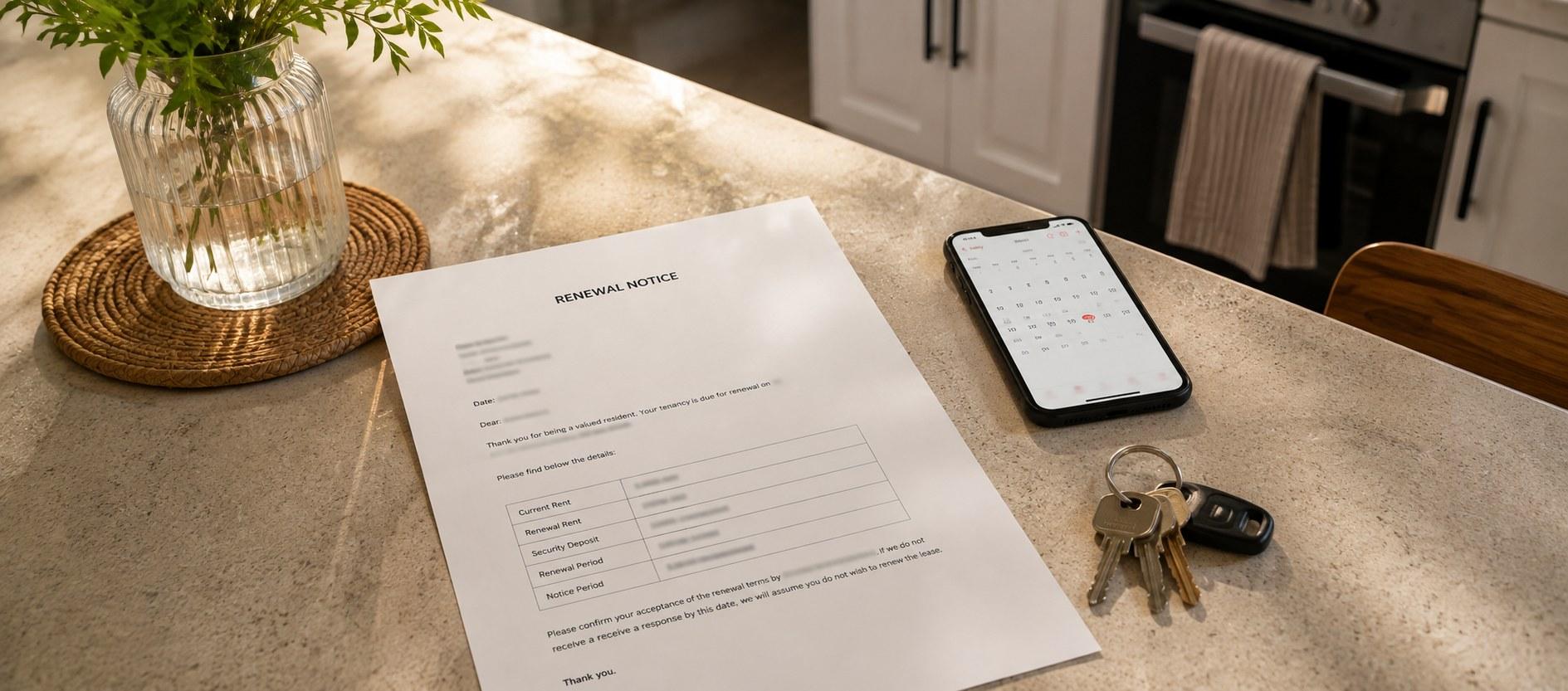
A renewal notice arrives with a number on it and most tenants treat it as a decision that has already been made. It has not been. Dubai sets out both how much a rent may rise and how much warning has to be given, and the figure a landlord is entitled to is frequently lower than the one on the notice, and quite often nothing at all.
The short answer
A Dubai landlord may only raise rent within the bands set by Decree No. 43 of 2013, which permit no increase where the rent sits within 10% of the market rate for comparable properties, rising in steps to a maximum of 20% where it sits more than 40% below. Any change requires at least 90 days written notice before renewal.
- The notice
- At least 90 days in writing before the renewal date, for any change of terms including the rent
- The bands
- Decree No. 43 of 2013: nothing, then 5%, 10%, 15% and 20%, according to how far below market the current rent sits
- The reference
- The Dubai Land Department rental index and its published increase calculator
- Eviction
- 12 months notice through a notary public or registered post, only on the grounds set out in the law
- Where disputes go
- The Rental Disputes Centre at the Dubai Land Department
Two things decide whether an increase is lawful
Both have to be satisfied. A landlord who gets the amount right and the notice wrong is in the same position as one who gave proper notice of a figure they were never entitled to ask for.
The notice, at least 90 days before renewal
Any change to the terms of a tenancy, the rent included, requires at least 90 days written notice before the renewal date, unless both parties agree otherwise. This is not 90 days for the tenant to decide. It is 90 days before the tenancy renews. A notice served inside that window does not take effect on that renewal, and the tenancy continues on its existing terms.
The amount, within the index bands
Dubai does not permit a landlord to name a figure. The permitted increase is set by how far the current rent sits below the market rate for comparable properties in the same area, measured against the Dubai Land Department's rental index. Where the rent is already at or near the market rate, the permitted increase is zero.
The bands, in full
Decree No. 43 of 2013 sets five steps. The comparison is between the rent currently being paid and the average market rent for a comparable property in the same area, as the Land Department's index measures it.
Within 10% of the market rate: no increase
The most common outcome by some distance, and the one landlords are most surprised by. A tenant paying close to the going rate cannot lawfully be asked for more at renewal.
11% to 20% below market: up to 5%
The first band in which any increase is permitted at all.
21% to 30% below market: up to 10%
Typically a tenancy that has run several years without review.
31% to 40% below market: up to 15%
Uncommon outside long tenancies in communities where rents have moved quickly.
More than 40% below market: up to 20%
The maximum permitted in a single renewal. There is no band above it, whatever the gap.
Why the calculator so often returns nothing
Tenants expect the index to justify some increase and are surprised when it justifies none. The reason is that the index compares the rent being paid against the market rate for comparable properties, and most tenancies signed in the last year or two are already at that rate. There is no gap for a band to apply to.
The gap opens over time and in one direction: a tenant who has stayed several years while rents rose around them. That is the situation the bands were written for, and it is why the steps get larger as the gap widens. It is also why a landlord who has kept a good tenant at a below-market rent for four years may be entitled to a meaningful increase, and one who signed a new tenancy last year at the going rate is entitled to nothing.
What a landlord cannot do
Two limits catch people out, and both come up more often than the increase itself.
A landlord cannot end a tenancy in order to rent the property out again at a higher rent. Recovery of the property requires 12 months notice, served through a notary public or by registered post, and only on the specific grounds set out in Dubai's tenancy law, such as selling the property or the owner moving into it. Wanting more rent is not one of them.
And notice has to be served properly. A message, a phone call or a conversation in the lobby does not start the clock on anything, whether the subject is an increase or the end of the tenancy. If it is not in writing and it cannot be evidenced, it did not happen.
If you are the landlord reading this
The commercial answer and the lawful answer point the same way more often than owners expect. A tenant paying on time, in a property that has not been vacant since they moved in, is worth more than the increase the index would have permitted anyway. A void of even one month, plus the cost of re-marketing and a new commission, wipes out a great deal of a 5% rise.
Where an increase is properly available, the way to secure it is to serve notice on time and to show the working. A notice that arrives 90 days out with the calculator result attached is a different conversation from one that arrives late with a figure and no explanation.
We serve renewal notices on the date they are due for properties we manage, run the calculator on the actual unit rather than on a guess, and tell owners when the honest answer is that nothing is available this year. That is a less satisfying conversation than the alternative and a considerably cheaper one than losing a good tenant to a notice that was never enforceable.

Renting, answered straight
The questions that come up most often on this, with the figures rather than a brochure answer.
Only within the bands set by Decree No. 43 of 2013, which depend on how far your current rent sits below the market rate for comparable properties in the same area. Where the rent is within 10% of the market rate no increase is permitted at all. From there the permitted maximum rises in steps of 5%, 10%, 15% and 20%. The Dubai Land Department's rental increase calculator returns the figure for a specific property.
A change to the rent or to any other term requires at least 90 days written notice before the renewal date. Notice served inside that window does not take effect at that renewal, and the tenancy continues on its existing terms unless both parties agree otherwise. Keep the notice and the envelope or the message it arrived in, because the date it was served is the fact in question.
Not in order to rent the property out again at a higher rent. Recovering possession requires 12 months notice, served through a notary public or by registered post, and only on the grounds set out in Dubai's tenancy law, such as the owner selling the property or moving into it themselves. Notice given informally does not start the clock.
The Dubai Land Department publishes a rental increase calculator that returns the permitted figure for a specific property once you enter the area, the property type, the size and the current rent. It is the reference point in any disagreement, and it is worth running before responding to a renewal notice rather than after.
Disputes go to the Rental Disputes Centre at the Dubai Land Department, which handles tenancy cases in Dubai. Cases turn on documentation, so the registered Ejari certificate, the tenancy contract, the notice as it was served and the calculator result are what the matter is decided on. Continue paying rent as it falls due while a dispute is running.
More on how Dubai property actually works.
Get the answer for your property
This page is general by definition. The version that matters accounts for your building, your service charge and the contract in front of you, and that is a conversation rather than an article.
What we will tell you
- Which end of the district
- Within one community the gap between two towers, or two streets, is routinely wider than the gap between communities. That is the part a portal map cannot show you.
- What the service charge does
- Read per square foot against the buildings beside it, because it comes out of the return every year and rarely appears in the pitch.
- What is still to be built
- The plot next door, what is approved on it, and which views are temporary. Worth knowing before you pay for one.
- What actually transacted
- Recent sale and lease prices in the specific building, rather than the asking prices still sitting on the portals.