
Palm Jumeirah
Two markets sharing one postcode and one road. The villas on the fronds and the apartments on the trunk attract different buyers, move at different speeds and are affected by entirely different things, so almost every general statement about the Palm is true of one and false of the other. The island also has a structural fact no amount of money changes: everything leaves the same way.
- Ownership
- Freehold, all nationalities
- Built of
- Villas, apartments, branded residences
- Master developer
- Nakheel
- Public transport
- Monorail, on the trunk only
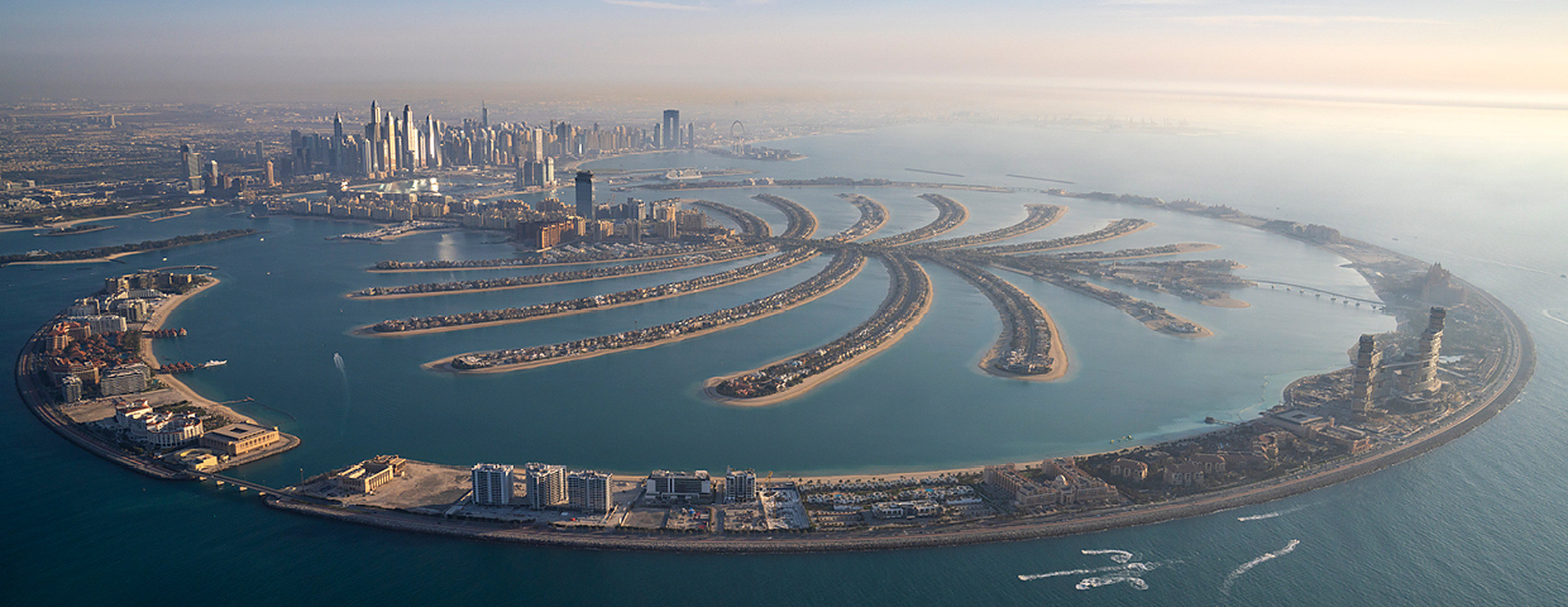
The whole island from the air. The crescent runs along the outside, the villa fronds sit inside it, and the mainland skyline behind is Dubai Marina.
The fronds, the trunk and the crescent
The island's three parts are not variations on a theme. They differ in what you own, what you pay to run it, who your neighbours are and how long it takes to sell. Getting the Palm right starts with being clear which of the three you are actually buying into.
The fronds
Villas only, no through traffic, and beach frontage or a short walk to it. Which frond you are on and which side of it you face decides the light and the outlook: one side looks back at the mainland skyline, the other at open sea. They are different products at different prices and neither is described by the words sea view.
The trunk
The apartment buildings along the spine, from the original beachside blocks to the newest towers. Most Palm transactions happen here and the range is enormous, from unrenovated original stock to new branded residences a few hundred metres apart.
The crescent
The outer breakwater, reached by tunnel, and largely hotels and branded residences. A resort address rather than a residential one. Excellent for a second home used seasonally, harder to justify as the place you leave from every morning.
The older beachside stock
The first generation of apartment buildings at the base of the trunk, many with beach club access and most now well past their original specification. This is the part of the Palm where the renovation budget, rather than the purchase price, is usually what decides whether a deal is good.
What actually moves the price here
The Palm is the district where the biggest variables are the least negotiable. Position on the island and the condition of the asset carry more weight than anything a floor plan shows.
Which frond, and which side of it
Sunrise over the mainland skyline and sunset over open water are different propositions with different buyers and different prices. Both are advertised identically. This is the single largest variable on a villa and it cannot be changed afterwards.
Whether the beach is actually yours
Private beach frontage, shared beach access and beach club membership are three different things sold with similar language. Establish which one is attached to the title before anything else, because on a frond villa it is most of what you are paying for.
The condition of the original build
A large share of the island's villas and early apartments remain close to their original specification. Renovation here costs more than the same work inland: access is restricted, contractors charge for the island, and salt air is unkind to everything. Price the work before you price the property.
Where you sit along the trunk
Everything leaves the island by the same route. A property at the tip and one at the base are on the same island and not on the same commute, and that difference is felt twice a day, every day.
The service charge, and what it covers
Beach, landscaping and community maintenance on a man-made island is expensive and the charges reflect it. On the older buildings ask what the reserve fund looks like as well as what the annual bill is, because deferred marine and structural work eventually arrives as a special levy.
What is being built beside you
The Palm is not finished. New towers along the trunk have already changed outlooks that owners had treated as permanent, and a view sold as protected is worth checking against what the neighbouring plot is permitted to become.
One island, one road on and off, and a monorail almost nobody commutes on.
The trunk is the only way out
Every journey from the Palm begins on the same road. Outside peak hours it is unremarkable and residents rarely mention it. At peak, and during events at the resorts on the crescent, it is the first thing they mention. Where you sit along the trunk matters more here than almost any other location factor.
The monorail, honestly
It runs the length of the trunk to the resort end and connects to the tram at the gateway. It was built for visitors rather than commuters, it is priced and timetabled accordingly, and residents treat it as an amenity rather than as transport. Do not buy on the assumption that it replaces a car.
What the island does not have
No schools. Nurseries only. The nearest schools are on the mainland, which puts the school run onto the trunk twice every weekday. For families with school-age children this single fact decides the Palm more often than anything about the property does.
Who Palm Jumeirah is for
Buy or rent here if
- Buyers who want beach frontage and privacy inside the city rather than an hour outside it.
- Second-home owners using the property seasonally, for whom the trunk at rush hour never becomes a daily fact.
- Investors at the branded and serviced end, where the island's name does real work on nightly rates.
- Villa buyers prepared to renovate properly and hold, which is where most of the value on the fronds has been made.
Look elsewhere if
- Families with school-age children, unless the drive off the island twice a day is genuinely acceptable.
- Anyone commuting to Downtown or the financial district at a fixed time every morning.
- Buyers who need liquidity. Frond villas are a thin market and the right buyer takes longer to arrive than an equivalent Marina apartment would.
- Anyone comparing the Palm on price per square foot alone, which flattens two very different markets into one misleading number.
Palm Jumeirah, answered straight
The questions buyers and tenants ask us about this district before they ask about a property, answered without the parts that suit us.
Yes. Palm Jumeirah is a designated freehold area, so buyers of any nationality can own villas and apartments there outright, with the title deed issued in your name by the Dubai Land Department. UAE residency is not required to buy or to hold.
They are separate markets that happen to share an address. Frond villas are low-density, have beach frontage or direct access, sit on private roads with no through traffic, and trade slowly to a small pool of buyers at high values. Trunk apartments are where most Palm transactions happen: a wide range from unrenovated original stock to new branded residences, with far more liquidity, a broad rental market and service charges that vary hugely between buildings. They move at different speeds and respond to different things, so market commentary about the Palm as a whole is usually describing only one of them.
Effectively yes. The trunk carries the traffic for the whole island, with a tunnel continuing to the crescent at the far end. It works well outside peak hours, and at peak or during large events at the crescent resorts it becomes the defining inconvenience of living there. This is why position along the trunk matters so much: a property near the base and one near the tip are on the same island but not on the same journey. Drive it at the time you would actually be driving it before you commit.
There are nurseries on the island but not schools. Families with school-age children drive to the mainland, which means the school run uses the trunk twice a day in both directions. For some households that is a manageable trade for beach access and privacy; for others it is the fact that rules the Palm out. It is worth mapping the actual route to your intended school at the actual time before deciding.
No, and the language used in listings blurs this more than it should. Some villas have direct private beach frontage forming part of the property. Others have access to a shared stretch of beach, and some apartment buildings provide beach club access rather than beach ownership. These are materially different rights at materially different prices. Establish exactly what is attached to the title deed, in writing, before you make an offer, because on a frond villa this is most of what you are buying.
They cover the ordinary building costs plus the things a man-made island needs: beach and shoreline maintenance, extensive landscaping, community security and the marine environment's effect on everything exposed to it. They are correspondingly higher than a comparable mainland property. Charges are set per building or community, approved by the Dubai Land Department and paid through the Mollak system, so the figure is checkable before purchase. On older buildings ask separately about the reserve fund, because deferred structural or marine work tends to arrive later as a special levy rather than in the annual charge.
It depends entirely on which Palm you buy. The branded and serviced end has a genuinely international buyer pool and a name that supports short-stay rates. Unrenovated original stock can be excellent value or a renovation project that consumes the margin, and the difference is a builder's assessment rather than a broker's opinion. Frond villas have delivered strongly for long-term holders but are a thin market to exit quickly. Rather than quote you a return for the island, we would rather look at a specific property, the condition survey, the service charge and the reserve fund, because on the Palm those three decide it.
What we do in the communities we write about.
Get advice on the frond or the trunk
Most Palm mistakes come from applying what is true of the fronds to the trunk, or the reverse. Tell us which of the two you are actually looking at, and what the property is for, and the shortlist gets shorter and better very quickly.
What we will tell you
- Which end of the district
- Within one community the gap between two towers, or two streets, is routinely wider than the gap between communities. That is the part a portal map cannot show you.
- What the service charge does
- Read per square foot against the buildings beside it, because it comes out of the return every year and rarely appears in the pitch.
- What is still to be built
- The plot next door, what is approved on it, and which views are temporary. Worth knowing before you pay for one.
- What actually transacted
- Recent sale and lease prices in the specific building, rather than the asking prices still sitting on the portals.