
Jumeirah Village Circle
The community where the building matters more than the address by a wider margin than anywhere else in Dubai. JVC was sold plot by plot to dozens of developers, so a single street can hold a well-run tower and a poorly built one facing each other. Bought carefully it is among the most productive apartment stock in the city. Bought carelessly it is why people warn you that the returns here are a trap.
- Ownership
- Freehold, all nationalities
- Built of
- Apartments, townhouses, villas
- Master developer
- Nakheel
- Public transport
- None. Car essential
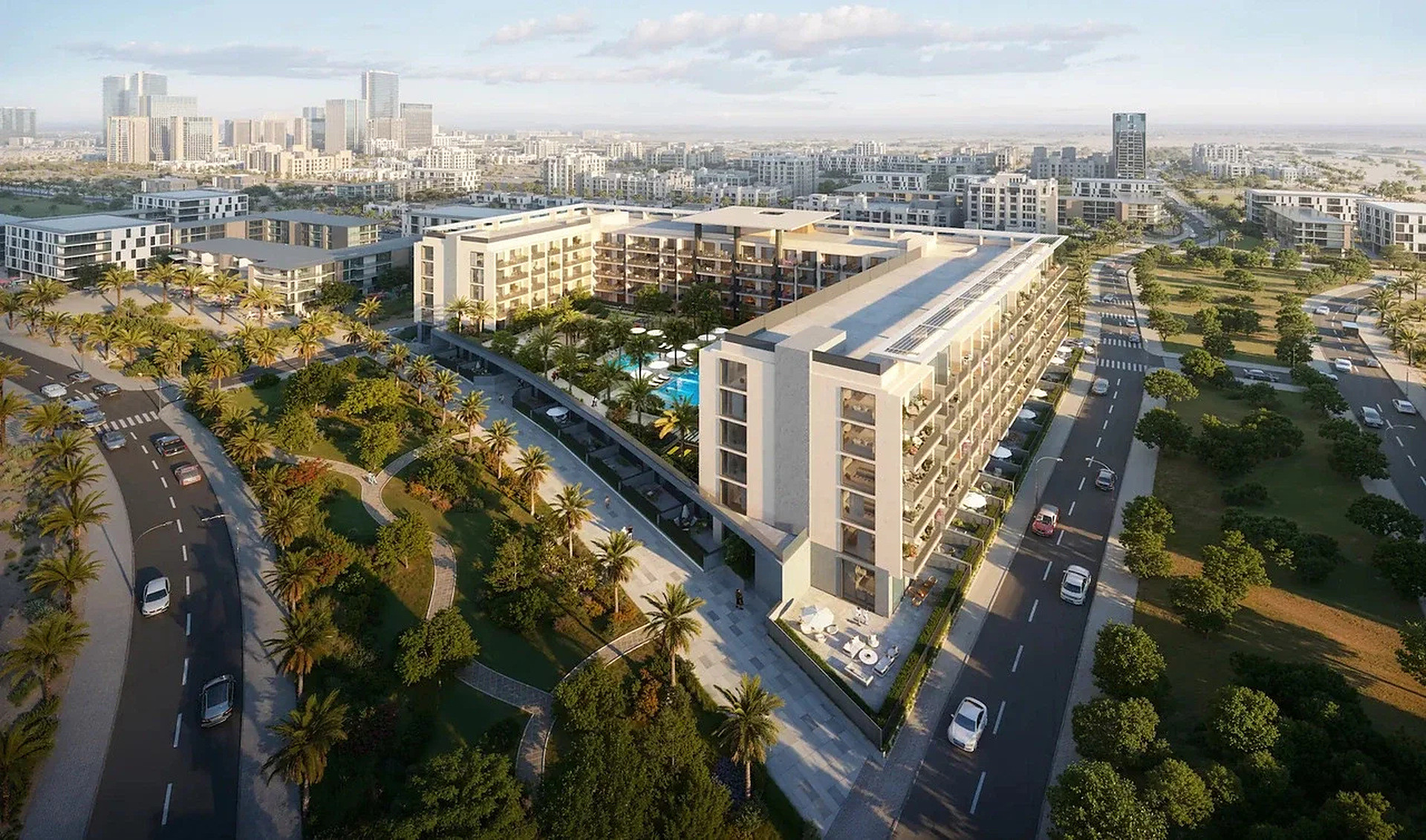
The circular road the community is named for, with the district park inside it and the mid-rise ring behind.
One community, assembled by dozens of hands
Most Dubai communities were built by one developer to one standard. JVC was not: the master developer laid out the plan and sold the plots on, so what got built varies from plot to plot. That is the single most important thing to understand about it, and it explains almost every good and bad story you will hear.
The circle itself
The central district park and the ring road around it. The community's one genuinely shared amenity, and the buildings facing it hold value on a different basis from the rest, because what is in front of them is not going to become another tower.
The villa and townhouse districts
The original low-rise plots. Quieter, family-occupied, and a different market entirely from the apartment buildings around them. This is the part of JVC people are surprised by, and the part that behaves most like a conventional suburb.
The mid-rise belt
The bulk of JVC and the bulk of its transactions. Dozens of developers, no consistent standard, and a spread in build quality wider than anywhere else in the city. Two buildings facing each other here can differ in lifts, glazing, maintenance and running costs to a degree that is difficult to believe until you have seen both.
The motorway edge
Closest to Al Khail, fastest to leave from, noisiest to live on, and generally the cheapest entry into the community. Whether that trade works is a question about the glazing and about which floor you are on.
The plots still building
JVC is not finished and empty plots are the norm rather than the exception. A quiet corner today can be a site within the year, and the roads and parking in the denser blocks are still catching up with what has already been built on them.
What actually moves the price here
In a community assembled from dozens of developers, due diligence on the building is not a formality before the purchase. It is the purchase. Nowhere else in this guide does the same money buy such different things on the same street.
Who built it, and what else they have built
This is the first question in JVC rather than the fifth. A developer's older buildings are the specification sheet that matters, and they are three minutes away and open to walk into. Look at the lifts, the corridors and the car park of something they finished five years ago.
The service charge against the value of the unit
JVC has some of the widest variation in the city, and a high charge on a modest apartment removes the exact thing that brought you to the community. It is set per building and published, so there is no reason to be guessing at it.
Whether the building has visitor parking
Some do not. Street parking in the denser blocks is already at capacity, and this is a daily problem rather than an occasional one. It affects what a tenant will pay and how quickly the unit rents.
What is on the plot next door
Empty plots surround a great deal of JVC. A unit sold on its outlook can be facing a construction site within a year, and in a mid-rise building at close spacing that is felt more sharply than it would be from the thirtieth floor of a tower.
How much of the building is short-term rental
Density is high across the community, and in a mid-rise building with two lifts it is noticed far more than the same proportion would be in a large tower. It changes the corridor, the lift wait and what a long-term tenant will accept.
The age of the building
The gap between JVC's earliest buildings and its newest shows up in the glazing, the lifts and the maintenance bill long before it shows in the asking price. An older building at a keen price is sometimes exactly that and sometimes a deferred bill.
Wedged between two motorways, with no station, no tram and no plan for either.
The roads
Al Khail Road on one side and Sheikh Mohammed Bin Zayed Road on the other, with Hessa Street across the top. The connectivity is genuinely good and it is a large part of why the community works at the price it does: most of Dubai is reachable without crossing the city.
No public transport
No metro station and no tram. Every household here runs a car and tenants price that in when they compare JVC with a district on the Red Line. Any listing describing the community as well connected means well connected by road.
What is inside
A mall, community parks, schools and nurseries, and the district park at the centre. Enough for daily life without leaving, and not enough to make the community walkable in the way Marina or Downtown genuinely are. Treat it as a suburb with good motorway access, because that is what it is.
Who Jumeirah Village Circle is for
Buy or rent here if
- Investors who will do the work on the building rather than buy the postcode, because that is where the returns here actually come from.
- First-time Dubai buyers who want a freehold apartment at an entry the famous districts do not offer.
- Landlords who want tenant demand that does not depend on one employer, one industry or one season.
- Families who want a townhouse with a small garden inside the city rather than out at its edge.
Look elsewhere if
- Anyone who wants finished surroundings now. Construction is ongoing across the community and will be for some time yet.
- Buyers who will not inspect the specific building, or cannot get someone to do it for them. In JVC that inspection is the whole exercise.
- Anyone without a car, or expecting to rely on public transport.
- Buyers who want a prestige address for its own sake, which JVC has never pretended to be.
Jumeirah Village Circle, answered straight
The questions buyers and tenants ask us about this district before they ask about a property, answered without the parts that suit us.
Yes. JVC is a designated freehold area, so buyers of any nationality can own apartments, townhouses and villas there outright, with the title deed issued in your name by the Dubai Land Department. UAE residency is not required to buy or to hold.
Because entry prices are low relative to the rent the units achieve, and that gap is the return. Tenant demand is broad rather than tied to a single employer or industry, and the community is well placed on two motorways, which keeps units occupied. What decides whether the gap survives is what sits underneath it: the service charge on that specific building, how long the unit stands empty between tenancies, and whether the building will need work the owners association has not funded. We would rather show you those three figures for a particular building than quote a percentage for the community, because the community figure is an average across buildings that have almost nothing in common.
Because of how the community was created. The master developer laid out the plan and sold individual plots to a large number of separate developers, each of whom built to their own standard, budget and timetable. The result is a community with no consistent specification: lifts, glazing, common areas, maintenance regimes and running costs can all differ sharply between two buildings facing each other across a street. It is not a defect in the community so much as the defining fact about it, and it is why the developer behind a building is the first question to ask here rather than an afterthought.
Five things, in this order. Who built it and what their older buildings look like today, which you can go and see. The service charge for that specific building, set against the value of the unit rather than in isolation. Whether the building has visitor parking, because many do not and the streets are already full. What the neighbouring plots are permitted to become, since empty plots are the norm here. And how much of the building is running as short-term rental, which in a mid-rise with two lifts is felt far more than it would be in a tower. If those five come back well, the rest of the diligence is ordinary.
No. There is no metro station and no tram serving Jumeirah Village Circle, and every household there runs a car. Road connectivity is genuinely strong, with Al Khail Road and Sheikh Mohammed Bin Zayed Road on either side and Hessa Street across the top, which is a large part of why the community works at its price. But tenants comparing JVC with a district on the Red Line will price the absence in, and you should too.
Yes, in parts, and it will be for some time. Empty and part-built plots are spread across the community rather than concentrated in one corner, so a quiet outlook is not necessarily a permanent one. The sensible approach is the same one that applies in Business Bay: look at what the neighbouring plots are permitted to become, assume they eventually get built, and decide whether the property still works for you when they are.
Both, for different people. The villa and townhouse districts are quiet, family-occupied and offer a garden inside the city at a price the established family communities do not, which suits households who would rather not commute in from the edge of the city. The apartment belt is more mixed, with a high proportion of tenants and short-stay occupiers, and living there depends much more on which building you are in. What JVC does not offer is walkability or a prestige address, so if either of those is what you are buying, this is not the community for it.
What we do in the communities we write about.
Get the developer's record on your building
Everywhere else the area guide is most of the work. Here it is the opening paragraph. Give us the buildings you are considering and we will tell you who built them, what their older stock looks like now, what the service charge does to the return, and which of them we would not put our own money into.
What we will tell you
- Which end of the district
- Within one community the gap between two towers, or two streets, is routinely wider than the gap between communities. That is the part a portal map cannot show you.
- What the service charge does
- Read per square foot against the buildings beside it, because it comes out of the return every year and rarely appears in the pitch.
- What is still to be built
- The plot next door, what is approved on it, and which views are temporary. Worth knowing before you pay for one.
- What actually transacted
- Recent sale and lease prices in the specific building, rather than the asking prices still sitting on the portals.